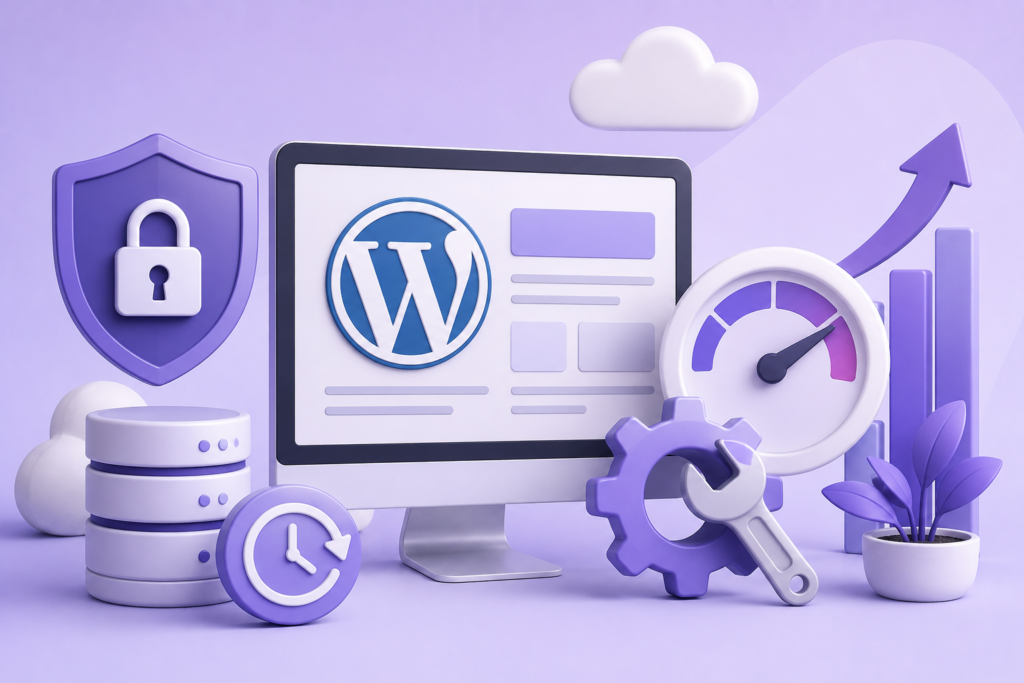
WordPress maintenance keeps your website secure, fast, updated, and reliable. Learn how to manage updates, backups, security, performance, databases, SEO, and ongoing website health.
Introduction
A WordPress website is not a set-it-and-forget-it asset. Once a site is launched, its software, plugins, themes, database, hosting environment, content, security configuration, and performance requirements continue to change. Without a structured maintenance process, small technical problems can gradually become serious issues that affect security, loading speed, search visibility, user experience, conversions, and business continuity.
WordPress maintenance is the ongoing process of inspecting, updating, securing, optimising, testing, and improving a WordPress website so it continues to perform reliably. It includes much more than clicking the update button in the WordPress dashboard. Effective maintenance requires a systematic approach to software updates, backups, security checks, performance monitoring, database housekeeping, broken-link detection, uptime monitoring, compatibility testing, and technical SEO validation.
The official WordPress site maintenance documentation recommends regular maintenance activities such as updating WordPress, checking for dead links, backing up the website, cleaning unused components, and validating the website after changes. A healthy WordPress installation should also remain updated, secure, properly maintained, and compatible with the required server software.
For businesses, maintenance is ultimately about risk management. A website that works today can still contain outdated plugins, vulnerable components, excessive database records, broken forms, expired integrations, performance bottlenecks, or failed backups. A professional maintenance process identifies these problems before they become expensive emergencies. Throughout this guide, we will examine how to build a practical WordPress maintenance system that protects website reliability while supporting long-term growth.
What Is WordPress Maintenance and Why Does It Matter?
WordPress maintenance is the continuous management of the technical and operational components that keep a WordPress website functioning correctly. It covers WordPress core updates, plugin and theme management, backups, security monitoring, performance optimisation, database cleanup, uptime checks, compatibility testing, content-quality checks, and technical SEO validation. The objective is not simply to make a website look functional when someone visits it. The objective is to maintain a dependable digital environment in which visitors can browse pages, submit forms, complete transactions, access content, and interact with features without unnecessary friction.
One of the biggest misunderstandings about maintenance is that it only becomes necessary when something breaks. In reality, preventive maintenance is usually more valuable than emergency repair. WordPress websites are built from multiple interconnected components. A plugin update can affect a theme. A theme change can affect JavaScript behaviour. A PHP upgrade can expose compatibility problems. A database that has accumulated years of unnecessary records can become inefficient. A security vulnerability can remain unnoticed until an attacker exploits it. A backup that has never been tested may appear successful while being unusable during an emergency.
This is why maintenance should be treated as an ongoing operational discipline rather than an occasional technical task. The official WordPress maintenance documentation covers updates, housekeeping, recovery mode, and other routine activities. A useful maintenance system establishes clear responsibilities, records what changed, checks whether the website still works after changes, and maintains a recovery path if something goes wrong. For a small brochure website, this may involve a monthly technical review combined with automated monitoring. For a busy ecommerce website, publishing platform, membership site, or lead-generation website, maintenance may need to be more frequent and more carefully controlled.
Build a WordPress Maintenance Schedule That Matches Your Website
A strong maintenance schedule begins by recognising that not every WordPress website has the same operational risk. A small website with a handful of pages and minimal traffic does not require exactly the same maintenance frequency as an ecommerce store processing orders every hour. A membership website with user accounts has different security requirements from a simple company website. A news website publishing multiple articles every day creates different database and content-management demands. The correct approach is therefore to create a risk-based maintenance schedule rather than blindly following the same checklist for every installation.
Daily or automated monitoring can cover uptime, critical security notifications, backup status, transaction failures, and major availability problems. Weekly maintenance can include reviewing updates, checking backups, examining security alerts, monitoring website performance, and looking for obvious errors. Monthly reviews can go deeper by examining database health, broken links, forms, user accounts, plugin usage, media libraries, redirects, search visibility, and performance trends. Larger quarterly reviews can assess the entire technology stack, including hosting, PHP compatibility, themes, plugins, integrations, analytics, SEO configuration, and business requirements.
The official WordPress site maintenance guidance recommends creating a maintenance calendar and performing maintenance activities regularly. This is important because maintenance failures frequently happen when responsibility is unclear. A site owner may assume the hosting provider is handling everything, while the hosting provider may only be responsible for server-level infrastructure. Likewise, an automated backup may be running without anyone verifying whether restoration actually works. A maintenance schedule should therefore identify what is checked, how often it is checked, who is responsible, what tool is used, and what happens if a problem is discovered.
Keep WordPress Core, Plugins, and Themes Properly Updated
Software updates are one of the most important parts of WordPress maintenance because updates can address security vulnerabilities, bugs, compatibility problems, performance issues, and functionality improvements. The official updating WordPress documentation explains the available update process and recommends backing up before significant upgrades. However, responsible updating is more than immediately clicking every available update without considering the website’s environment.
Before significant updates, create a reliable backup and understand what components are changing. WordPress documentation specifically recommends backing up before updating because the upgrade process affects core files and changes can sometimes introduce compatibility problems. For higher-risk websites, updates should ideally be tested in a staging environment before being applied to production. This is particularly valuable when the website depends on page builders, ecommerce functionality, custom plugins, complex themes, payment gateways, booking systems, or third-party APIs.
Plugin and theme management also requires discipline. An installed component that is no longer required increases maintenance overhead and may create unnecessary security or compatibility exposure. Removing unused plugins is generally preferable to leaving them installed indefinitely. Likewise, a theme should not be retained merely because it was once useful. The maintenance process should regularly identify abandoned, redundant, unsupported, or unnecessary components. The goal is a leaner WordPress installation with fewer points of failure, not a dashboard containing dozens of components that nobody actively manages.
Create a Reliable WordPress Backup and Recovery Strategy
A backup is only valuable if it can actually restore the website. This distinction is critical. Many website owners believe they are protected because their hosting provider or backup plugin reports that a backup completed successfully. However, a maintenance strategy should consider whether the backup contains both the website files and database, whether copies are stored independently, how long backups are retained, and whether restoration has been tested.
The official WordPress backups documentation explains that a complete WordPress backup normally requires both the website files and database. Website files contain WordPress core files, plugins, themes, uploaded media, configuration files, and other components, while the database contains posts, pages, comments, settings, and other dynamic information. Backing up only one of these components may leave the website impossible to restore completely.
A mature backup strategy should also include off-site redundancy and restoration testing. Keeping every backup on the same hosting account creates a single point of failure. If the server becomes compromised, inaccessible, or corrupted, local backups may be affected as well. Consider maintaining multiple recent recovery points in separate locations and periodically testing restoration on a controlled environment. The purpose of a backup is not to create files; it is to create confidence that the website can be recovered after accidental deletion, failed updates, malware, hosting failure, database corruption, or another serious incident.
Strengthen WordPress Security Through Preventive Maintenance
Website security should be integrated into everyday WordPress maintenance rather than treated as a separate project. Security maintenance includes keeping software updated, reducing unnecessary access, using strong authentication practices, monitoring suspicious activity, reviewing administrator accounts, protecting configuration files, maintaining backups, and selecting trustworthy plugins and themes. The official WordPress hardening documentation covers several important practices for strengthening a WordPress installation.
A common security mistake is assuming that a security plugin alone makes a website secure. Security plugins can provide useful detection and protection features, but they cannot compensate for an outdated WordPress installation, weak administrator passwords, compromised hosting credentials, abandoned plugins, insecure third-party code, or poor backup practices. Security is best understood as a layered system. The more independent controls you have, the less likely a single failure is to become a complete website compromise.
Access management deserves particular attention. Every administrator account increases the number of credentials that could potentially be compromised. Maintenance should therefore include reviewing users and removing accounts that are no longer required. Administrator access should be limited to people who genuinely need it, while lower-privilege roles should be used wherever possible. Authentication should be strengthened through appropriate measures such as strong unique passwords and multi-factor authentication where supported.
Monitor WordPress Website Performance and Core Web Vitals
Performance maintenance is not simply about achieving a high score in a testing tool. A fast website should provide a responsive and stable experience for real visitors across realistic devices and network conditions. WordPress performance can be affected by hosting quality, database size, plugins, themes, images, JavaScript, CSS, caching, third-party scripts, server configuration, and inefficient application behaviour. A maintenance programme should therefore monitor performance trends instead of treating speed optimisation as a one-time task.
Google’s Core Web Vitals initiative focuses on user-centred performance measurements. Core Web Vitals include Largest Contentful Paint (LCP) for loading performance, Interaction to Next Paint (INP) for responsiveness, and Cumulative Layout Shift (CLS) for visual stability. These metrics help developers and site owners evaluate important aspects of the actual user experience.
A practical WordPress maintenance process should combine laboratory testing with field data. Tools such as PageSpeed Insights, Lighthouse, Chrome DevTools, and Search Console can help identify different categories of performance problems. The important point is to diagnose the cause instead of applying random optimisation techniques. If LCP is slow, investigate server response time, image delivery, render-blocking resources, and page structure. If INP is poor, examine JavaScript execution and long-running tasks. If CLS is high, identify images, advertisements, fonts, or dynamically injected elements that cause unexpected movement.
Maintain the WordPress Database and Remove Unnecessary Data
The WordPress database is one of the most frequently overlooked areas of website maintenance. Over time, a busy installation can accumulate revisions, transient records, spam comments, expired metadata, abandoned plugin tables, orphaned data, and other information that may no longer contribute to the website’s operation. Not every database record should automatically be deleted, however. Aggressive database cleaning can create new problems if legitimate information is removed without understanding its purpose.
The right approach is controlled database housekeeping. Before performing significant cleanup, create a verified backup and identify what type of data is being removed. Database optimisation should be based on evidence rather than a desire to make the database appear smaller. For example, post revisions can be useful during content production, while some transient data may be regenerated automatically. Plugin-created tables require additional caution because removing them without understanding their function can break functionality or permanently delete configuration or historical data.
The official WordPress housekeeping guidance discusses cleaning unwanted plugins, themes, images, and database overhead. The goal is not to make the database as small as possible; the goal is to keep it healthy, organised, recoverable, and appropriate for the site’s current needs.
Audit Plugins and Themes for Compatibility, Quality, and Risk
A WordPress website can gradually become difficult to maintain when plugins and themes are added without a clear technology strategy. Each component introduces code, dependencies, settings, database activity, and potential compatibility considerations. Over several years, a website may end up with plugins that overlap in functionality, themes that are no longer supported, or components that are technically active but no longer required.
A proper plugin audit should examine whether each plugin has a genuine business or technical purpose. Ask whether it is still needed, whether it is actively maintained, whether it receives security updates, whether it overlaps with another plugin, whether it creates performance problems, and whether its functionality can be handled more efficiently. The official WordPress hardening guidance also recommends obtaining plugins and themes from trusted sources.
Theme maintenance deserves the same attention. A theme is not simply a visual layer; depending on its architecture, it may influence templates, styles, scripts, accessibility, performance, custom functionality, and content presentation. Before replacing or heavily modifying a theme, document customisations and test the website in a staging environment. A well-maintained website should have a clear component inventory, with each plugin and theme justified, monitored, updated, and removed when it no longer provides sufficient value.
Test Forms, Checkout Functions, Login Systems, and Critical User Journeys
Technical monitoring can tell you that a website is online without telling you whether its most important functions actually work. A homepage may load perfectly while a contact form silently fails. An ecommerce store may display products while payment processing is broken. A membership website may load correctly while password resets fail. This is why functional testing should be part of WordPress maintenance.
Identify the critical journeys that directly affect the purpose of the website. For a lead-generation website, these may include contact forms, phone links, quote requests, appointment forms, and confirmation emails. For ecommerce websites, they may include product search, cart functionality, checkout, payment processing, order confirmation, account creation, and transactional emails. For membership websites, they may include registration, login, password reset, protected content, profile updates, and subscription management.
Testing should happen after significant changes and at planned intervals. Do not assume that because a form worked last month it will continue working indefinitely. APIs change, email providers modify authentication requirements, payment gateways update their integrations, and plugins can introduce compatibility issues. A useful maintenance report should record the date of the test, the functionality tested, the result, and any corrective action. This creates an evidence-based maintenance history and helps demonstrate real operational control rather than simply claiming that a website is maintained.
Protect SEO During WordPress Maintenance
WordPress maintenance can directly affect organic search performance when technical changes alter URLs, indexing settings, internal links, page content, redirects, canonical signals, structured data, or site accessibility. SEO should therefore be included in technical maintenance rather than handled only during content campaigns.
Google’s Search Essentials explain that websites should meet technical requirements, follow spam policies, and focus on helpful, reliable, people-first content. Google’s technical requirements also explain the basic conditions that allow Google Search to access and process web content. This means maintenance should include checking whether important pages remain crawlable and indexable after updates or configuration changes.
Google also emphasises creating helpful, reliable, people-first content rather than producing pages primarily to manipulate search rankings. From a maintenance perspective, this means avoiding the temptation to add unnecessary keyword-heavy content simply because a keyword tool suggests it. Instead, maintain existing content for accuracy, usefulness, clarity, internal-link relevance, and search intent. Regularly check important URLs, redirects, metadata, canonicalisation, XML sitemaps, robots directives, structured data, mobile usability, and internal linking.
Check Broken Links, 404 Errors, Redirects, and Internal Linking
Broken links are more than a minor cosmetic problem. They can interrupt user journeys, prevent visitors from reaching important information, create unnecessary 404 responses, and indicate that a website has not been maintained carefully. The official WordPress site maintenance documentation specifically recommends checking for dead links as part of ongoing website housekeeping.
Internal linking should be reviewed whenever pages are deleted, renamed, reorganised, or migrated. If an important page moves from one URL to another, the old URL should generally have an appropriate redirect rather than simply disappearing. However, redirects should not be created blindly. Each redirect should make sense for the original visitor intent and should point to the most relevant current destination. Redirect chains and unnecessary redirect hops should also be avoided.
A useful maintenance process can divide link checks into three categories: internal links, external links, and important conversion paths. Internal links should be reviewed for 404 errors and outdated destinations. External links should be monitored for pages that have disappeared or moved. Conversion paths should receive manual testing because automated tools may not understand whether a link leads to the correct business outcome.
Review WordPress Hosting, PHP, SSL, and Server Health
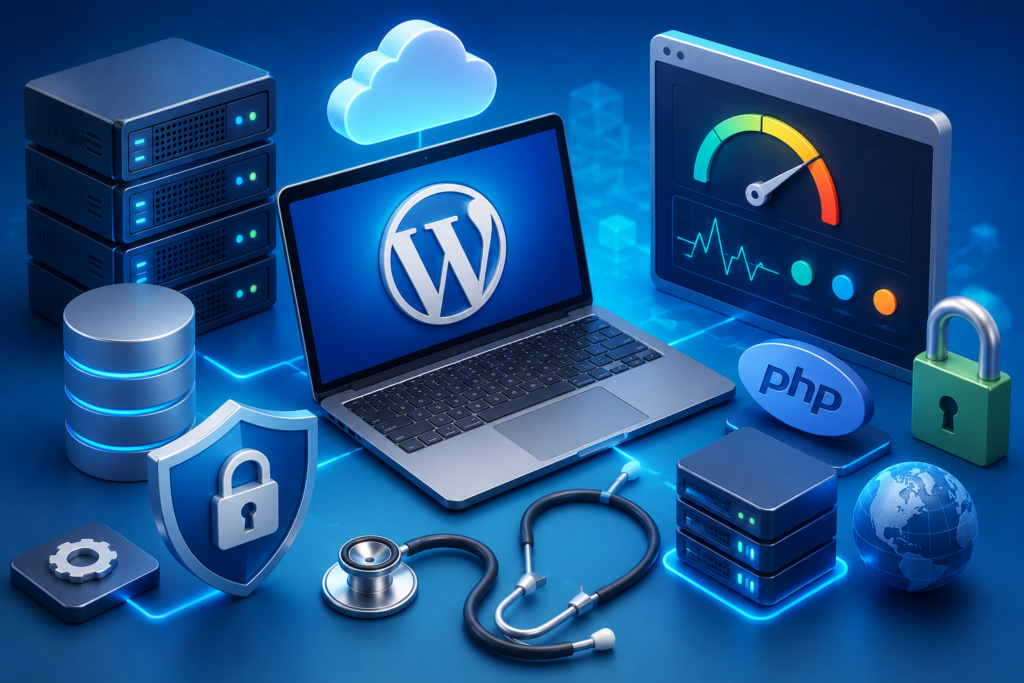
WordPress performance and security depend partly on the environment in which the application runs. Website owners sometimes focus entirely on plugins and themes while overlooking hosting configuration, PHP versions, database performance, storage limitations, server resources, SSL configuration, caching infrastructure, and server-level security. A technically clean WordPress installation can still perform poorly when the underlying environment is unsuitable.
The official WordPress Site Health documentation explains that a healthy WordPress website should be up to date, use appropriate PHP and related software versions, remain well maintained, and be secure. Hosting providers also play an important role in infrastructure reliability, backups, server software, and security processes.
A hosting review should therefore consider more than storage space. Examine server response times, available resources, database performance, backup arrangements, PHP compatibility, SSL status, caching options, staging availability, monitoring, and support quality. If a website repeatedly experiences slowdowns during traffic spikes, maintenance should investigate whether the problem originates from inefficient WordPress components or inadequate infrastructure. Moving to a better hosting environment may sometimes provide greater improvement than endlessly adding optimisation plugins.
Use WordPress Site Health and Technical Monitoring as Early Warning Systems
WordPress includes Site Health functionality that can help administrators identify technical issues affecting the installation. The official Site Health documentation explains that the feature checks the overall health of a website and provides information about configuration, updates, security, PHP, plugins, themes, and other technical areas.
However, Site Health should be treated as one component of a wider monitoring system. A clean Site Health screen does not automatically mean that every business-critical function is working. For example, a website could have no obvious Site Health warnings while a payment gateway is failing or a contact form is not delivering messages. Maintenance therefore needs multiple layers of observation: server monitoring, uptime monitoring, security alerts, backup verification, performance measurement, functional testing, and search visibility checks.
The most useful approach is to convert monitoring information into actionable maintenance decisions. A warning should have an owner, a priority, and a defined response. Critical issues should be addressed immediately, while lower-priority recommendations can be scheduled during planned maintenance windows. This prevents dashboards from becoming collections of ignored warnings. A mature maintenance process uses monitoring as an early-warning system that helps identify problems while they are still manageable.
Document Maintenance Work and Keep a Change History
Documentation is one of the simplest ways to improve WordPress maintenance, yet it is frequently ignored. When several people work on a website, nobody should have to guess what was changed, why it was changed, which plugin was updated, whether a backup was created, or whether testing was completed afterward. A maintenance log provides continuity and reduces the risk of repeating mistakes.
At minimum, record major updates, theme changes, plugin installations and removals, security incidents, database maintenance, user-account changes, hosting changes, PHP upgrades, URL changes, migrations, backups, restoration tests, and significant performance work. The record does not need to be complicated. A spreadsheet, ticketing system, maintenance platform, or internal documentation system can be sufficient as long as it is kept current and accessible to the appropriate people.
Documentation also strengthens operational trust. If a website experiences a problem six months after a major update, the maintenance history can help identify potential causes. If a developer leaves a project, the next developer can understand the technical environment more quickly. If a backup restoration is required, documented procedures reduce pressure during an emergency. In professional WordPress management, documentation is not administrative overhead; it is part of the site’s resilience strategy.
Turn WordPress Maintenance Into a Long-Term Website Improvement System
The strongest maintenance strategy does more than prevent failures. It creates a feedback loop in which information gathered from security monitoring, performance tests, analytics, user behaviour, search visibility, and technical audits is used to improve the website over time. Instead of waiting for problems to become urgent, maintenance becomes a structured way to identify opportunities and risks.
For example, performance monitoring might reveal that mobile visitors experience slower loading than desktop users. A database review might reveal unnecessary historical data. Security monitoring might identify repeated login attempts. Search performance might reveal that important pages are not receiving enough organic visibility. Functional testing might expose an unreliable form integration. Each observation can become an improvement task with a priority and measurable outcome.
This approach aligns with Google’s broader emphasis on people-first experiences and useful, reliable websites rather than search-engine manipulation. The principles outlined in Search Essentials and creating helpful, reliable, people-first content provide useful foundations for maintaining a technically sound and user-focused website.
A long-term maintenance system should ultimately answer five questions: Is the website secure? Is it recoverable? Is it functioning correctly? Is it performing efficiently? Is it supporting the business and its users? If the answer to each question is supported by monitoring, testing, documentation, and evidence, maintenance has moved beyond routine administration and become an important part of digital asset management.
Develop an Advanced WordPress Maintenance Workflow
A professional WordPress maintenance workflow should operate as a repeatable cycle rather than a collection of unrelated tasks. The first stage is assessment: identify the current WordPress version, active plugins and themes, hosting environment, PHP version, database condition, backup status, security configuration, performance profile, important URLs, and business-critical functionality. Without this baseline, it becomes difficult to determine whether the website is improving or deteriorating over time. Documentation should capture the current state so future maintenance work can be compared against a known reference point.
The second stage is controlled execution. Before making significant changes, establish a backup and, where appropriate, use a staging environment. Apply updates according to their risk and importance rather than making large numbers of unrelated changes simultaneously. After updates, test the homepage, navigation, forms, important templates, responsive layouts, ecommerce functions, authentication, third-party integrations, and other critical workflows. This creates a simple but powerful principle: every meaningful change should have a verification step. If something breaks, the maintenance record should make it possible to identify what changed and when.
The final stage is review and improvement. Record the outcome of the work, document unresolved issues, assess whether performance or security improved, and schedule follow-up actions. Over time, this workflow creates a maintenance history that can reveal patterns. If the same plugin repeatedly causes compatibility problems, it may need replacement. If hosting resources are consistently exhausted, infrastructure may need improvement. If security alerts repeatedly identify suspicious login activity, authentication controls may need strengthening. An advanced workflow transforms maintenance from reactive troubleshooting into a structured system of continuous website reliability management.
Use Staging Environments for High-Risk WordPress Changes
A staging environment is a separate copy of a website where changes can be tested before they are introduced to the live site. It can be particularly valuable for major WordPress core updates, PHP upgrades, theme changes, ecommerce modifications, database operations, plugin replacements, and custom development. Testing in staging reduces the risk that visitors encounter a broken website while technical changes are being evaluated.
The value of staging depends on how closely it represents the production environment. A staging site that uses different PHP settings, different plugins, a different database structure, or incomplete content may produce misleading results. For important websites, the staging process should reproduce the major characteristics of production as closely as practical. Sensitive information should also be handled appropriately when copying production data into a testing environment. The objective is to create a controlled place where potential problems can be discovered before they affect real users.
Staging does not eliminate the need for production monitoring. A change that works correctly in staging can still behave differently in production because of traffic, external APIs, caching, server resources, DNS, payment gateways, email delivery, or other environmental differences. After deployment, perform a production smoke test covering the most important functions. A good maintenance workflow therefore uses staging and production validation together: test before deployment, deploy carefully, and verify immediately afterward.
Manage WordPress Security Updates According to Risk
Not every software update presents the same operational risk, and not every security issue has the same urgency. A mature maintenance process should distinguish between routine feature updates, bug fixes, compatibility releases, and security-related updates. Security issues that affect actively used components may require faster attention than minor feature changes, particularly when a vulnerability has public documentation or evidence of exploitation.
The official WordPress security documentation provides guidance on securing WordPress installations, while the WordPress Security Team works on identifying and addressing security issues within the WordPress ecosystem. Website owners should use reputable sources for security information rather than relying on unverified social-media claims or sensational headlines.
Risk management should also consider the importance of the affected component. A vulnerability in a plugin that controls payment processing, user authentication, file uploads, or administrator functionality may deserve a different response from a minor issue in a component with limited exposure. Maintenance teams should therefore maintain an inventory of important components, monitor relevant security announcements, apply appropriate updates, and have a rollback or recovery plan available. Security maintenance works best when it is prioritised, documented, and evidence-driven.
Maintain WordPress User Accounts and Access Permissions
User management is often overlooked after a website has been launched. Over time, employees leave, contractors finish projects, developers change, and temporary accounts remain active. Every unnecessary account creates additional administrative overhead and can increase security risk. WordPress maintenance should therefore include a regular review of user accounts, roles, permissions, and authentication practices.
Start by identifying every administrator and determining whether each account still requires that level of access. A content editor generally does not need administrator permissions, while a developer may require elevated access temporarily rather than permanently. Applying the principle of least privilege reduces unnecessary exposure. When people no longer need access, their accounts should be handled according to the site’s documented access policy rather than simply being forgotten.
Account security should extend beyond WordPress itself. Hosting accounts, domain registrars, DNS providers, analytics platforms, email services, payment systems, CDN accounts, and third-party integrations may all provide access to the website ecosystem. A secure maintenance strategy should know who controls these accounts, where recovery information is maintained, and how access is granted or revoked. Strong unique passwords and multi-factor authentication should be used wherever appropriate. The result is a more controlled environment in which access is intentional rather than accidental.
Keep Media Files and WordPress Content Organised
Media management is another area where WordPress websites can become inefficient over time. Businesses frequently upload multiple versions of the same image, oversized photographs, unused PDFs, outdated promotional assets, and files that are no longer referenced anywhere on the website. While individual files may appear insignificant, a large media library can increase storage requirements and make content management more difficult.
Before deleting media, determine whether the file is actually used. Images can appear in posts, pages, templates, widgets, custom fields, CSS, or third-party systems. Deleting files simply because they appear old can therefore break existing content. A better approach is to identify unused assets carefully, maintain important originals where appropriate, and optimise images before uploading them. Modern image formats and appropriate dimensions can reduce unnecessary transfer while preserving visual quality.
Content maintenance should also include reviewing outdated information. Business addresses, product descriptions, pricing, team information, legal notices, service details, contact information, screenshots, statistics, and references can become inaccurate. A website that is technically secure but contains outdated information can still damage trust. A strong maintenance process therefore combines technical housekeeping with content accuracy, ensuring that visitors encounter information that remains relevant and dependable.
Improve WordPress Performance Without Relying on Excessive Plugins
Performance optimisation should be based on diagnosis rather than plugin accumulation. Adding several caching, image optimisation, database cleaning, script management, and performance plugins can sometimes create conflicts or duplicate functionality. A faster website is not necessarily created by installing more optimisation tools. In some cases, the opposite can happen.
Start by identifying the actual bottleneck. If the server takes too long to respond, investigate hosting, database queries, caching, and application logic. If large images are responsible for slow loading, optimise the assets and serve appropriate dimensions. If excessive JavaScript delays interaction, identify the scripts responsible and evaluate whether they are necessary. If third-party services consume resources, assess whether their business value justifies their performance cost. Google’s PageSpeed Insights and the broader web performance documentation can help with measurement and diagnosis.
Caching can be useful, but it should be configured carefully. Page caching, browser caching, object caching, CDN caching, and server-level caching solve different problems. A caching strategy should also account for logged-in users, ecommerce carts, personalised content, dynamic forms, and other pages that cannot always be cached like static content. The objective is predictable performance, not simply a high laboratory score.
Monitor Uptime and Respond to WordPress Failures Quickly
Uptime monitoring provides a basic but important layer of operational awareness. A website can experience downtime because of hosting failures, DNS problems, database errors, resource exhaustion, plugin conflicts, security incidents, deployment mistakes, or expired services. Without monitoring, a business may not discover the problem until customers report it.
A useful monitoring system should check the website from outside the server rather than relying only on internal status information. If possible, monitor both the main homepage and selected important endpoints. For ecommerce websites, additional monitoring may be useful for critical customer journeys. Monitoring should also distinguish between a brief network interruption and a sustained application failure, reducing unnecessary alerts while ensuring serious incidents are detected quickly.
An incident response process should define what happens after an alert. First confirm whether the issue is genuine. Then identify the likely scope and recent changes. If necessary, place the website into a safe state, restore from a known-good backup, disable a problematic component, or contact the hosting provider. After recovery, document the incident and identify its root cause. This final step is essential because restoring a website without learning from the failure leaves the underlying weakness in place.
Maintain WordPress SEO Architecture During Redesigns and Migrations
Website redesigns and migrations are high-risk maintenance events because technical changes can affect hundreds or thousands of URLs simultaneously. A redesign may change navigation, templates, page hierarchy, internal links, metadata, structured data, images, content, and URL structures. Without careful preparation, a website can lose organic visibility even though the redesigned website looks better.
Before a migration, create a complete inventory of important URLs. Identify pages that receive organic traffic, backlinks, conversions, or significant internal links. Map old URLs to their appropriate new destinations and implement redirects where necessary. Review canonical tags, robots directives, XML sitemaps, internal links, structured data, metadata, and page accessibility after launch. Google’s documentation on site moves provides guidance for websites moving to new URLs.
Post-migration validation is equally important. Monitor crawl errors, indexing changes, traffic patterns, important landing pages, and search performance. Do not assume that the migration is successful merely because the new website loads correctly. Search engines need time to process changes, while users and external websites may continue accessing old URLs. A well-managed migration therefore combines technical preparation, URL mapping, redirects, testing, monitoring, and post-launch validation.
Make Accessibility Part of Ongoing WordPress Maintenance
Accessibility should not be treated solely as a design-stage consideration. Website content changes constantly, and new pages, images, forms, buttons, menus, documents, and interactive components can introduce accessibility problems after the original website launch. Maintenance should therefore include periodic accessibility reviews.
Common areas include keyboard navigation, colour contrast, alternative text, form labels, heading structure, link clarity, focus indicators, semantic HTML, accessible menus, and readable content. Automated tools can help identify potential issues, but automated testing cannot detect every usability barrier. Manual testing remains valuable, particularly for important user journeys.
Accessibility also benefits overall website quality. Clear headings improve content structure, descriptive links improve navigation, properly labelled forms reduce confusion, and responsive layouts benefit users across devices. Maintaining accessibility is therefore not merely a compliance exercise. It contributes to a more usable website for a broader range of visitors. A practical maintenance strategy should review accessibility whenever major templates, themes, plugins, forms, or content structures change.
Maintain Analytics and Conversion Tracking
A technically functional website can still make poor business decisions if its analytics implementation is inaccurate. Tracking codes can disappear during theme changes, events can stop firing after plugin updates, consent configurations can change, and ecommerce tracking can become unreliable. Analytics validation should therefore be part of WordPress maintenance.
Start by documenting the important business events that should be measured. Depending on the website, these might include contact-form submissions, phone interactions, purchases, account registrations, newsletter subscriptions, downloads, bookings, or quote requests. After significant website changes, verify that the relevant events still occur and that data is being recorded correctly.
Analytics should also be interpreted carefully. A sudden traffic decline may result from a tracking problem rather than an actual loss of visitors. Likewise, a sudden increase in conversions could reflect duplicate event tracking. Google’s Analytics documentation provides technical resources for implementation and measurement. Maintaining accurate measurement gives decision-makers confidence that website changes are being evaluated using reliable evidence rather than assumptions.
Common WordPress Maintenance Mistakes
One of the most common mistakes is updating everything at once without a backup or testing process. While many updates work correctly, a single compatibility problem can affect an entire website. Updating WordPress core, a page builder, a theme, and several plugins simultaneously makes troubleshooting significantly harder because there are multiple possible causes. A safer approach is to maintain backups, use staging for high-risk changes, update methodically, and test important functions afterward.
Another frequent mistake is ignoring unused plugins, themes, and administrator accounts. Website owners sometimes believe that inactive plugins cannot create meaningful risk, but unnecessary software increases complexity and can become a maintenance burden. Similarly, old administrator accounts may remain active long after a person has stopped working on the website. Regular audits help reduce unnecessary components and access points.
A third mistake is relying entirely on automated tools. Automated backups, security scanners, performance plugins, uptime monitors, and SEO tools are valuable, but they cannot replace human verification. A backup can report success without a restoration test. A security scanner can miss a sophisticated compromise. A performance tool can report good laboratory results while real users experience poor interaction. A mature maintenance strategy therefore combines automation with human testing and professional judgement.
Additional Real-World WordPress Maintenance Mistakes to Avoid
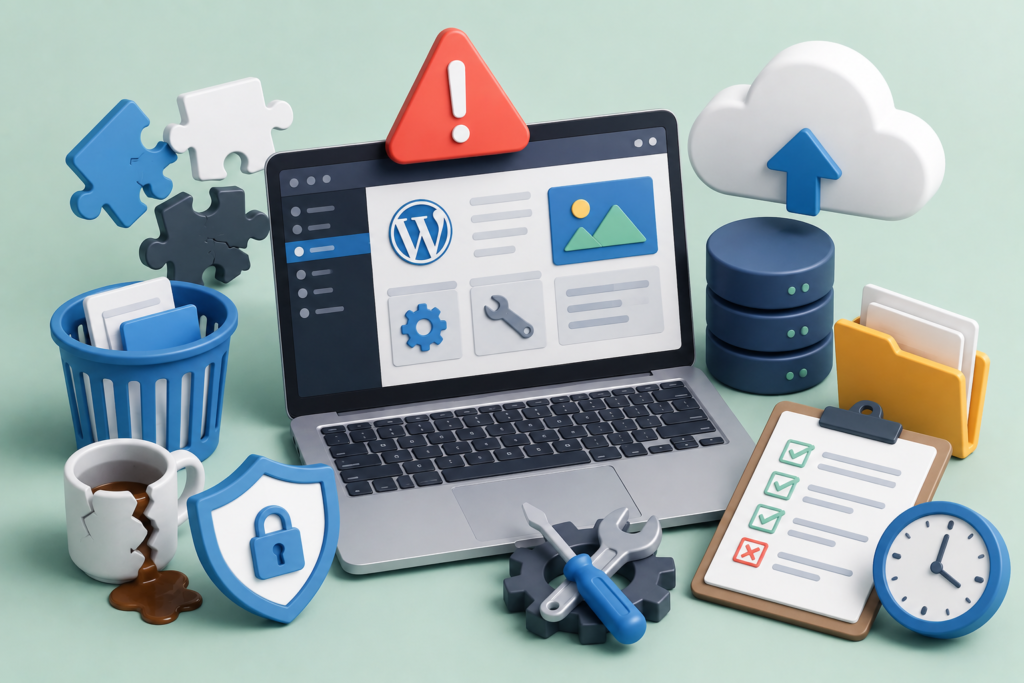
Another mistake is treating website maintenance as an emergency-only activity. When maintenance is postponed until a website breaks, the resulting work is often more expensive and stressful. An outdated plugin, neglected backup, and ignored performance problem can combine into a major incident. Preventive maintenance spreads the workload over time and allows problems to be addressed before they become critical.
Some website owners also perform database cleanup without understanding what they are deleting. Database optimisation tools can remove records efficiently, but efficiency does not equal safety. Always create a reliable backup before destructive operations and understand the data involved. The same principle applies to deleting media files, changing URL structures, modifying DNS records, and removing plugins.
Finally, many organisations fail to document changes. A developer may remember why a setting was changed today but forget six months later. Another developer may then undo the change and accidentally recreate the original problem. A simple maintenance log can prevent this cycle. Documentation should capture significant decisions, changes, tests, incidents, and recovery actions so the website does not depend on one person’s memory.
Best Practices Summary
The first best practice is to maintain a tested backup and recovery process. Backups should include the necessary website files and database, be stored appropriately, and be tested periodically. A backup that cannot be restored should not be considered a dependable recovery strategy.
The second is to keep the WordPress technology stack current and controlled. Maintain WordPress core, plugins, themes, PHP, and related components according to compatibility and security requirements. Remove unnecessary software and avoid installing plugins simply because they offer attractive features. Every additional component should have a clear purpose and a responsible maintenance owner.
The third is to monitor rather than guess. Track uptime, security, performance, backups, important functionality, SEO health, and analytics. Use tools such as Google Search Console, PageSpeed Insights, WordPress Site Health, and appropriate monitoring systems to collect evidence. When an issue appears, investigate its root cause instead of repeatedly applying superficial fixes.
The fourth is to test important user journeys. Forms, checkout, login, password recovery, payment processing, booking systems, search functionality, and other business-critical features should be tested regularly. Technical dashboards cannot always detect failures that matter most to customers.
The fifth is to document everything important. Keep a change history, component inventory, backup information, migration records, security incidents, and recovery procedures. Documentation makes maintenance easier to transfer, audit, troubleshoot, and improve.
Frequently Asked Questions
How often should WordPress maintenance be performed?
WordPress maintenance should be performed continuously, but the frequency of individual tasks depends on the website’s risk profile. Automated monitoring can operate daily, while updates, backups, security reviews, performance checks, and functional tests can follow weekly or monthly schedules. High-traffic ecommerce, membership, publishing, and transaction-heavy websites generally require more frequent monitoring than simple informational websites.
Is WordPress maintenance necessary if the website is not being updated?
Yes. Even a website that rarely receives new content still depends on software, hosting, security controls, databases, SSL certificates, integrations, and external services. Vulnerabilities can be discovered in components even when the website owner has not changed anything. Maintenance protects the website against problems that occur simply because the technology environment continues to evolve.
Should WordPress updates be automatic?
Automatic updates can be useful for some websites and components, but they should be evaluated according to the site’s complexity and risk. WordPress provides automatic update functionality, but businesses with highly customised websites, ecommerce systems, or complex integrations may prefer controlled update procedures with backups and testing. The important issue is not whether updates are automatic or manual; it is whether the update process includes appropriate recovery and verification.
How often should a WordPress website be backed up?
Backup frequency should reflect how quickly important website data changes. A website that publishes content once a month may require a different schedule from an ecommerce website processing orders throughout the day. The more frequently important data changes, the more frequently meaningful recovery points should be created. Regardless of frequency, restoration testing is essential.
Can WordPress maintenance improve SEO?
Proper maintenance can support SEO by protecting crawlability, website availability, performance, internal links, redirects, mobile usability, structured data, and technical accessibility. However, maintenance itself does not guarantee higher rankings. Search visibility depends on many factors, including relevance, content quality, technical accessibility, authority, competition, and user experience. Google’s Search Essentials provide the foundation for maintaining a technically compliant search presence.
Does deleting unused plugins make WordPress faster?
Removing unnecessary plugins can reduce complexity and may improve performance when those plugins load resources, execute code, add database queries, or perform background tasks. However, deleting plugins is not automatically a performance solution. The correct approach is to measure performance, identify the actual bottleneck, and remove unnecessary components safely.
What should be checked after a WordPress update?
After an update, check the homepage, navigation, important templates, forms, menus, responsive layouts, login functionality, search, ecommerce features, payment processing, emails, third-party integrations, and other critical workflows. Also review the browser console and server logs when appropriate. The exact testing scope should reflect the functionality of the website.
What is the biggest WordPress maintenance mistake?
One of the most damaging mistakes is having no reliable recovery strategy. A website can survive an update problem if a recent tested backup exists. Without a dependable backup, even a relatively small technical failure can become a major business interruption. Prevention, monitoring, and recovery should therefore be treated as interconnected parts of maintenance.
Final WordPress Maintenance Checklist
A reliable WordPress maintenance process should verify the following areas regularly:
- WordPress core is maintained and appropriately updated.
- Plugins are reviewed, updated, and removed when unnecessary.
- Themes are maintained and unnecessary themes are removed.
- Backups include the required website files and database.
- Backup restoration has been tested.
- Administrator accounts are reviewed regularly.
- Strong authentication practices are in place.
- Security alerts are monitored.
- Hosting and PHP versions are reviewed.
- SSL configuration remains valid.
- WordPress Site Health is reviewed.
- Uptime is monitored.
- Important forms are tested.
- Ecommerce checkout is tested where applicable.
- Login and password recovery are tested.
- Database housekeeping is performed carefully.
- Unused media is reviewed before deletion.
- Broken links and 404 errors are monitored.
- Important redirects are documented.
- Internal links remain relevant.
- XML sitemaps remain accessible and accurate.
- Robots directives are reviewed after major changes.
- Canonical signals are checked.
- Structured data is validated where applicable.
- Core Web Vitals are monitored.
- Mobile performance is reviewed.
- Analytics tracking is tested after major changes.
- Critical SEO pages remain indexable.
- Website content remains accurate.
- Accessibility is reviewed.
- Significant changes are documented.
- Security incidents are recorded.
- Migration plans include URL mapping and redirects.
- Recovery procedures are documented and accessible.
Conclusion
WordPress maintenance is ultimately about protecting the value of a website after it has been built. A website is a living technical system, and its reliability depends on how consistently its software, security, performance, content, database, infrastructure, and integrations are managed. Ignoring maintenance may appear to save time in the short term, but unresolved technical debt can eventually result in downtime, security incidents, poor performance, broken functionality, lost search visibility, and avoidable recovery costs.
The most effective approach is systematic. Maintain dependable backups, update software responsibly, monitor security, review users and plugins, test important functionality, measure performance, protect SEO architecture, maintain accurate content, monitor uptime, and document meaningful changes. Use automation where it improves consistency, but retain human testing for the functions that matter most to customers and the business.
For organisations using WordPress as an important part of their digital presence, maintenance should be viewed as ongoing website stewardship rather than occasional technical housekeeping. A well-maintained website is easier to secure, easier to troubleshoot, easier to improve, and better prepared for future changes. The objective is not perfection; it is dependable operation supported by evidence, preparation, and continuous improvement.
At WP Maintenance Service, the central principle behind effective WordPress management is simple: protect the website before problems become business problems. A structured maintenance approach gives website owners greater visibility into their technology, reduces avoidable risks, and creates a stronger foundation for long-term growth.
Want to Implement This Easily?
Prompt Text:
You are an expert consultant. Based on the blog post titled “(WordPress Maintenance)”, provide a step-by-step, practical implementation guide. Include tools, best practices, common mistakes to avoid, and advanced tips. Assume the reader wants to implement everything discussed in this article effectively.
Call to Action: Want our help implementing this? Just reach out to us via our website contact form: contact us